
Seeing Hummingbirds
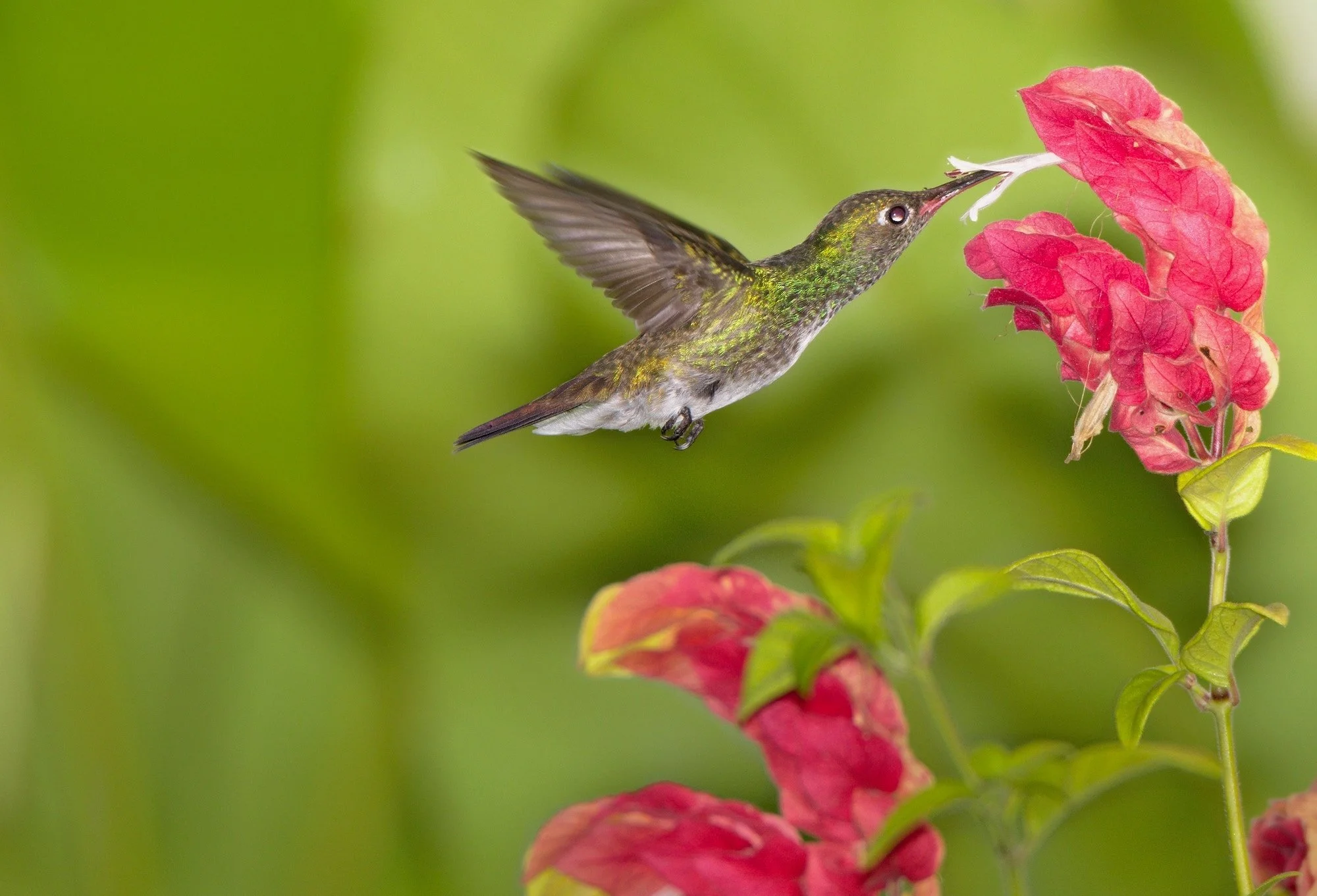
Something brewing in my heart-brain this week that was triggered watching the hummingbirds at my feeder last night. I’m not sure where it’s going! We’ll know when I get to the end, and, it has something to do with that well-known George Orwell quote that followed my bird watching:
To see what is in front of one’s nose needs a constant struggle. - George Orwell
To set the stage, I have one modest hummingbird feeder. I recently moved it to a new location on the other side of my house, since I’m starting a remodel one of these days and won’t be able to enjoy it from the kitchen window. Now, it hangs under an eave on the west side, close to a juniper tree, in line of sight with the sunset over the Cerrillos Hills. Sounds idyllic, doesn’t it?
And yet, last night, as is the habit in the year plus I’ve been observing the birds, they fight and hoard and attack to secure exclusive access to the feeder. “Sharing” is not seemingly in their vocabulary, but “I’m gonna get mine first” sure is. Sure, your inner biologist may be saying, “But they are each just trying to survive!” That is likely part of the equation here. But I want to share a little more math with you.There are three, equally distributed holes on the feeder. In theory, three birds could be sucking the sugar water at once. I’ve never seen that, though.When I first hung it, I was enthralled with the beauty and rapid wing beating of these beauties. I think I’ve identified at least three species. I’ll give them a little room for what ecologists call “speciation” in terms of hoarding the food source.
Speciation is how a new kind of plant or animal species is created. Speciation occurs when a group within a species separates from other members of its species and develops its own unique characteristics. 1
Unique characteristics aside, they all gotta eat! So the math of cooperation vs competition kicks in, and we all know millions of hours of study has been dedicated to that.
Looking at the birds and finding their aggressiveness, however well-intentioned, unpleasant, I realized I had once again projected a range of values onto the birds I had admired for their beauty. Link to my recent post in case you missed it":
It also perhaps led to the George Orwell quote. I had to take the time to actually observe their behavior to understand that hummingbirds are more than “pretty little things” and in fact are fierce competitors. They will sit in the juniper tree for much longer than I’d expect, well after the coast is clear, before venturing the 7’ to the feeder. Why? Because it’s likely that another bird will sweep in from far in the distance, and push them away. Often, the pusher will not even stop to eat. It just flys off having cleared the space.
All of this leads me to consciousness, of course, and how easy it is to make assumptions, how challenging it can be to admit wrongful thinking, and how it takes a lot of time to truly understand something.
I believe many of us are losing that ability, with our speed-scrolling habits of media consumption that have hijacked our thinking brains. I know, it’s all designed that way, AND, it’s up to us to be part of the resistance. Resistance in this example, is to sit still. To observe repeatedly over many days. To be willing to reject previous beliefs and assumptions.Which brings me back to George Orwell, again. I looked up the short quote that is often shared; it’s part of a longer essay.2
Here’s one paragraph that I especially liked, as it supports the ideas I’m exploring here:
To see what is in front of one’s nose needs a constant struggle.
One thing that helps toward it is to keep a diary, or, at any rate, to keep some kind of record of one’s opinions about important events. Otherwise, when some particularly absurd belief is exploded by events, one may simply forget that one ever held it. Political predictions are usually wrong. But even when one makes a correct one, to discover why one was right can be very illuminating.
In general, one is only right when either wish or fear coincides with reality. If one recognizes this, one cannot, of course, get rid of one’s subjective feelings, but one can to some extent insulate them from one’s thinking and make predictions cold-bloodedly, by the book of arithmetic. In private life most people are fairly realistic.
Feelings are a delicious rollercoaster of ups and downs that rise to the sky and descend into the dark green forests and I would never want to be without them. However! I do want to be the one who is in charge of saying when the ride is over for now; time to hop off and not stay strapped in to someone else’s ‘amusement park.’Is social media something like the hummingbirds? Viciously vying for attention to “feed the beast” that we now call the algorithm, dressed in shiny fast fashion and a lot of fascism, too? I think so. Having a diary is such good advice, for so many reasons. The willingness to examine ourselves is a supreme survival strategy at the moment. We make fun of the “sheep” online who fall for scams, and yet, where are we ourselves making inaccurate or overly broad assumptions? I know I fall for this; every day I aim for a clean slate and a chance to try again.I still think hummingbirds are beautiful and amazing creatures but I now realize I don’t want to be in the ring fighting them for food! Do I wish they could see what I see — the three holes for feeding? Do I wish they knew what I know — that I will fill the feeder every time it empties, so there is no scarcity? Do I wish they felt less panic about surviving — because so much of it is out of their control? The answers are yes, yes, and yes. The dear people of Maui learned just how little control they had when the fires descended.
We aren’t going to be changing the hummingbirds anytime soon. But what about us? Can we change? Can we get better at seeing what is right under our own noses? Oh, yes! Yes we can.